
Why you don’t have to ‘stay calm’.
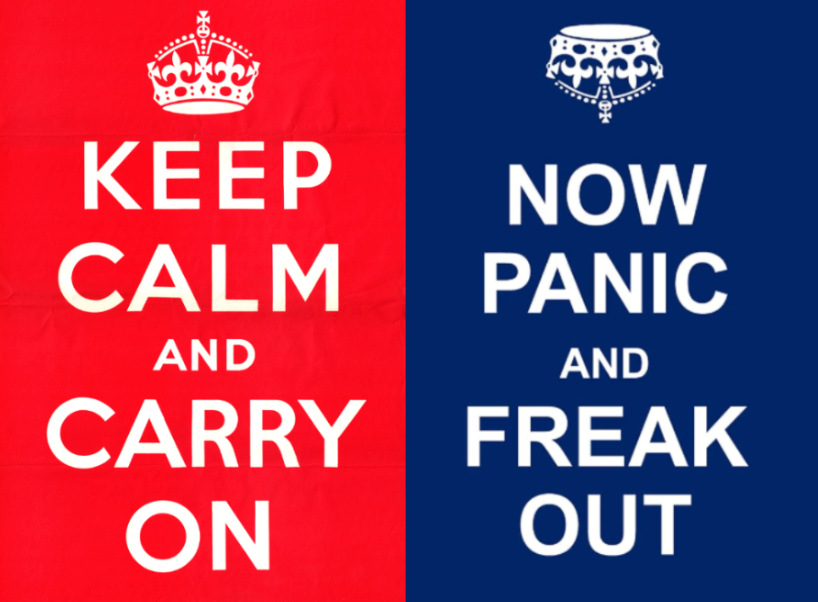
Keep Calm and Carry On, the 1939 UK government poster said, as the country prepared for bombs to blitz cities. The 2.5 million copies weren’t distributed but appealing to British stiff upper lip stoicism was considered a wartime strategy...
Today, the world’s superpower is unpredictable, extreme heat is literally causing potatoes to boil in the ground, and tech CEOs casually place the risk of human extinction in the next decade at 10%...
As someone who works in the transformational field, I can’t help but feel concerned when development spaces incline towards staying calm and positive while participants are in grief, anger, or utter confusion about all this. It’s a form of what therapist John Welwood called “spiritual bypass” and could be called “transformational bypass”: using deceptively comforting ideas and regulation practices to transcend the reality of uncertainty.
But what’s the alternative to stoicism? Do we give up all hope and wail?
The winter lake is calm. The spring river flows.
One thing I’ve learned from Long Covid and the uncertainty and vulnerability that came with it is that energy — and its coherence — is a great inner compass for decisions. Energy coherence is an often-hidden determinant of our decisions, even when we think we’re making them rationally. It also made clear that creating healthy boundaries is where we have some control. How we structure our lives and relationships may be one of the biggest factors in the decisions we make and the futures we create.
Boundaries channel energy, like the riverbanks that direct the river’s flow. We can’t control the sea, but we can channel the river. This is a very different approach from most coaching and leadership training, but is supported by the latest cognitive science, decades of social determinants of health research, and thousands of years of wisdom practices.
I hope to share an updated approach to boundaries on October 13th (more at the end of the email).
In the meantime, here are a few reflections on adjusting to real and perceived uncertainty without forced calm:
Focus at the level of energy rather than emotion or thinking:
Emotions are an interpretation of your uncertainty level, and they can be misleading. Beliefs and stories can reinforce the emotional momentum. We default to our habitual ways of thinking and emoting because we are often disconnected from our physical experience. As a result we ignore or misinterpret the physical sensations like heaviness or tightness in the body. On the other hand, energy is more directly connected to your physical state and environment, and is a more reliable guide for how to respond to a situation.
See everything you do as relational
Understand how you’re in a continuous dance between what came before and what comes next, between you and the other—impermanent circumstances giving rise to transient experience. Nothing is fixed, and nothing is truly lost. Life isn’t random or meaningless, but it’s not personal or controllable—as wisdom traditions have long tried to teach. Every action has a kind of butterfly effect in your life and environment and they affect you in return. Certain relationships strengthen as others loosen - making boundaries an ongoing process.
Work with boundaries as qualities of experience (not mental rules)
I call boundaries a practice in Compassionate Ruthlessness. When I embody it, I sense aliveness, freedom, and connection at the same time - and my actions are values-aligned while being impact-aware. Boundaries stop being barriers between you and an overwhelming other, and become a work of art combining your values, circumstances, and needs - within an interconnected ecosystem. Boundaries become living art rather than mental dilemmas in a changing world.
Embracing uncertainty isn’t about staying calm, but being present enough to detect changes in inner coherence - keeping it not too tight, not too loose but - like a beautifully tuned instrument, to borrow an analogy from the Buddha.
Me, you, we:
If you’re tired of dilemmas over who and what to prioritise in work and life and open to new approaches to boundaries and relationships, I’ve been working with Justin Navetski, who trains busy doctors and healthcare professionals in empathy without burnout, to co-design a special event. I asked him if he’d be willing to co-lead a 75-minute session on Compassionate Ruthlessness and how to apply it in daily interactions, and he agreed.
It’s an interactive webinar and dialogue, where you’ll explore:
your vital boundary between softness and swiftness;
how to show up more powerfully within an interaction rather than tolerate or over-react and regret it later
how to translate your truth into sincere words in real time
For more information and registration see below:
Compassionate Ruthlessness: Empathy Without Burnout
October 13th at 6pm UK / 1pm ET.
Have a good week,
Amina
Comments